
First nights as a new FY1 doctor

Date: Wed Jan 27 Author: Sheshank Raju

The step up from medical school to FY1 has been both challenging and rewarding. After 4 weeks settling in, it seemed daunting to work nights for the first time. As I was on a surgical rotation, my job overnight as an FY1 was to provide ward cover for all the surgical inpatients.

The shift starts at 9pm in acute surgical unit, where the day team hands over unfinished jobs – e.g. checking blood results, inserting cannulas and reviewing unwell inpatients. The day on call FY1 hands over the bleep – the device that allows the wards to communicate with you. Across the nights, I was receiving significantly more bleeps than I had been used to on the day job. In our training we often talk about developing time management and task prioritisation skills – these became vital to apply in order to complete tasks efficiently.

When reviewing unwell inpatients, I used a systematic approach drilled into us in medical school: A – airway; B – breathing; C – circulation; D – disability; E – exposure. For example, I was asked to review a patient with a blood pressure of 96/66. Her airway was patent, and her breathing was normal. When assessing her circulation, she appeared clinically dry and her fluid balance chart showed that she had been losing more fluid than she had been taking in. Therefore, I prescribed intravenous fluids to slowly rehydrate her overnight. Later on, I was called to see a patient with painful urinary retention. An ultrasound scan showed a distended bladder containing 1 litre of urine. This drained after inserting a catheter and he felt much better, which was very rewarding to see.

The hospital can be an intimidating place at night, and you can at times feel out of your depth.  However, there is support when you need it. When an urgent arrest call was put out, there were already 3 senior doctors on the scene before I arrived. This is when that buzzword “teamwork” becomes important to provide the best patient outcomes.

By Dr. James Ayathamattam
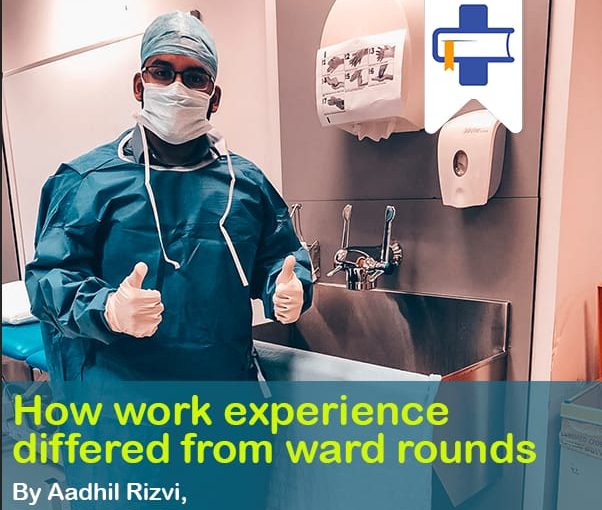
Work Experience vs Ward Rounds

Date: Sun Jan 24 Author: Sheshank Raju

I always looked forward for the opportunity to interact with real patients during hospital and clinical placements. Students in the above years always mentioned that it was as if your textbooks come to life. For pre-clinical years, we didn’t have much clinical exposure, with the emphasis on medical theory such as pharmacology and biochemistry. After this, we usually do an intercalated degree – mine was in Cardiovascular Sciences. Then comes 3 clinical years…

In my first few months, I started at the Royal Free Hospital in London – a place renowned for treating patients with infectious diseases such as Ebola. I arrived at the hospital early morning, both excited and nervous. The day starts with the morning handover, where the night shift team reports back key pieces of information about current patients. They relay this information using a succinct tool called SBAR (Situation, Background, Assessment and Recommendation). I realised the importance of that all-important buzzword ‘communication’ we fill in our personal statements – without it, you would be endangering safe continuity of care for patients that you treat.

We’re assigned a small group consisting of a consultant/registrar, juniors, nurses, physiotherapists and then, armed with a few facts and phrases you gleaned on the train ride to the hospital, we visited patients. This is more daunting than it seems as you’re put on the spot to answer questions asked by your seniors!

However, it’s rewarding when you learn important clinical signs to carry out supervised medical examinations such as checking their breathing, abdomen or assessing the state of neurological functions. It truly is fascinating to see all arms of the medical world come to play, with pharmacists conversing with doctors about prescriptions and physiotherapists aiding with breathing exercises

We also get to experience being assigned a junior doctor, great at refining our examination skills and helping us develop that much-needed clinical knowledge. I still remember one of the juniors playing a game of differentials with us – much like House, where we’d be given a clinical sign and have to suggest as many possible causes under a minute.